Every piece of feedback has two layers. There’s the content, the actual information about what happened in the scene. And then there’s the framing, which is how that information arrives. The tone of voice, whether it was said in front of the class or privately, whether your inner critic added its own spin before you even finished hearing the words coming out of your teacher’s mouth. Most of us respond to the framing, and quite often the content gets lost somewhere behind that framing.
This is the thing I keep coming back to in this metacognition series (this is the final episode of that series, btw). Eileen Gu did something really specific after a reporter framed her Olympic silver as “two golds lost.” She didn’t accept that frame and instead separated the useful content (her actual result, five Olympic medals, the most decorated female freestyle skier in history) from the emotional framing (you lost something) and responded to the content instead. Which is a skill we can build on in improv, and one of the ways we can apply it is to how we handle notes in improv.
Improv teacher Brian James O’Connell (BOC) has a framework for this that I really like (which he paraphrases it from a screenwriting teacher called Billy Mai, and now I’m about to paraphrase his paraphrase like a good ol game of telephone though hopefully it’s still accurate). Anyway. You put every note into one of three categories: “That’s great, I’m gonna try it.” Or “That’s how you would do it, and this is how I would do it.” Or “Fuck you, that’s crazy, I ain’t changing it.” The useful thing about these categories is that they require you to find the content first, which is our goal.
One thing that helps with all of this is writing the note down as close to the original words as you can, before your brain has time to rewrite it. Because by the time you’ve replayed the interaction a few times, the original note has probably been rewritten into something bigger and more personal than what was actually said. Your written version becomes the evidence and then the rumination version is more like an affirmation at that point and is henceforth not all that trustworthy.
Then there is the nervous system, and neurodivergent brains to think about. Which I do in this week’s episode. More on that below.
Get the Guides
This week is all about receiving feedback in improv… notes… the tough stuff. We’re going to talk about what it does to the brain, and how to handle it to make you a better improviser in the end. I have also recently dropped two lengthy guides about this subject, and this week is the final week to get a bonus add-on discount for the guides. One guide is focused on students, and the other if you’re teaching improv (how to give notes your students can utilize better). For more information on these guides, see this page. You can get 50% off a second guide if you grab both at once.
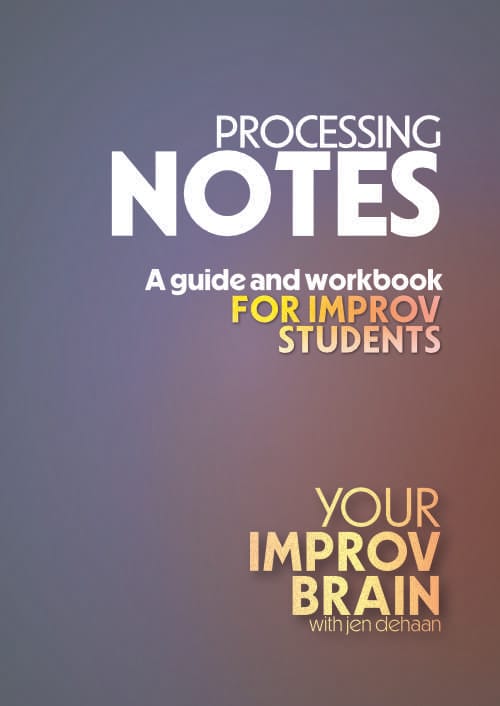
Processing Notes: Students Guide
25 Page Guide (with drawings!) and Workbook for improv students. 3 bonus interactive downloads linked in the workbook, too. Get both guides for a discount.
Get the Guide & Workbook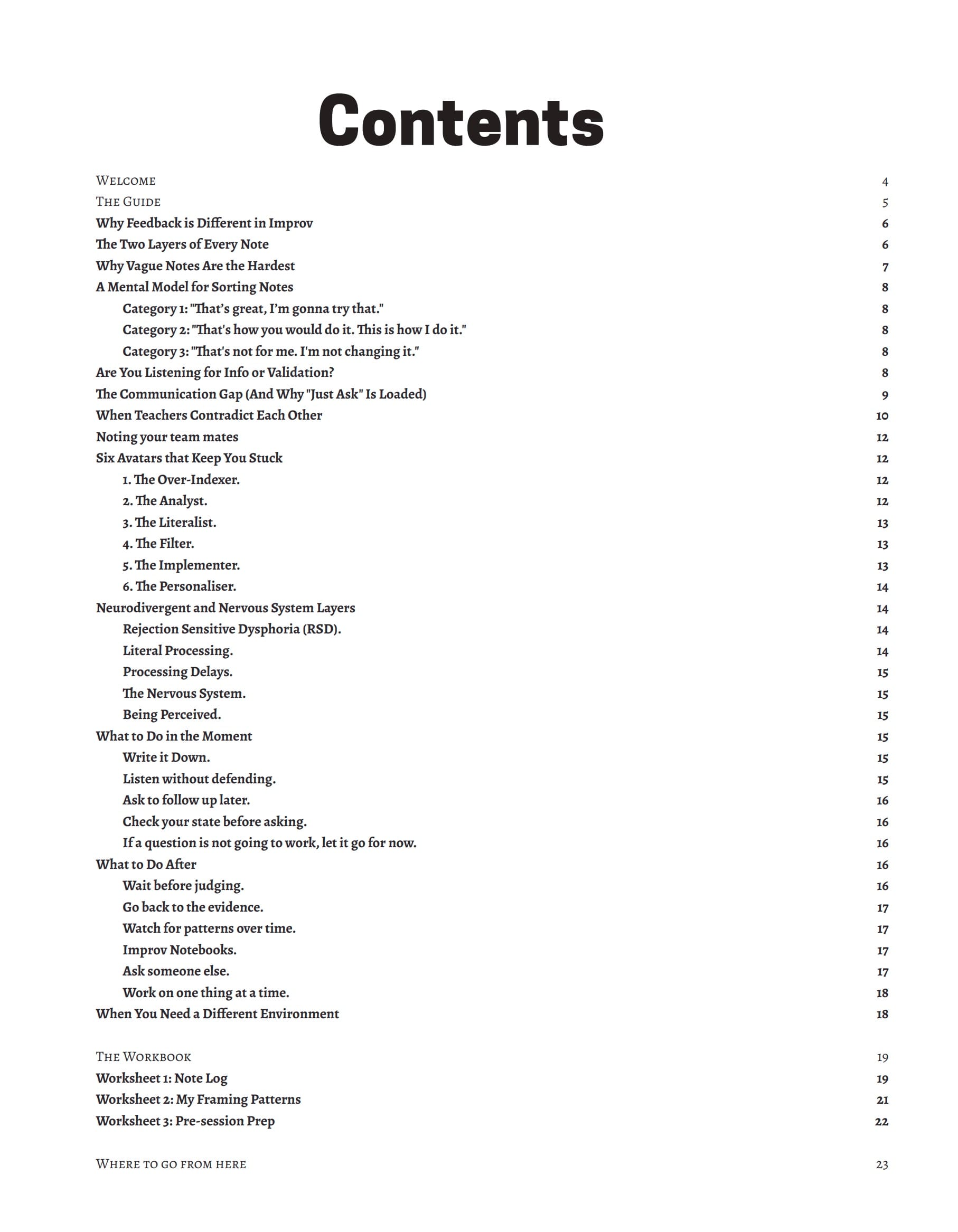
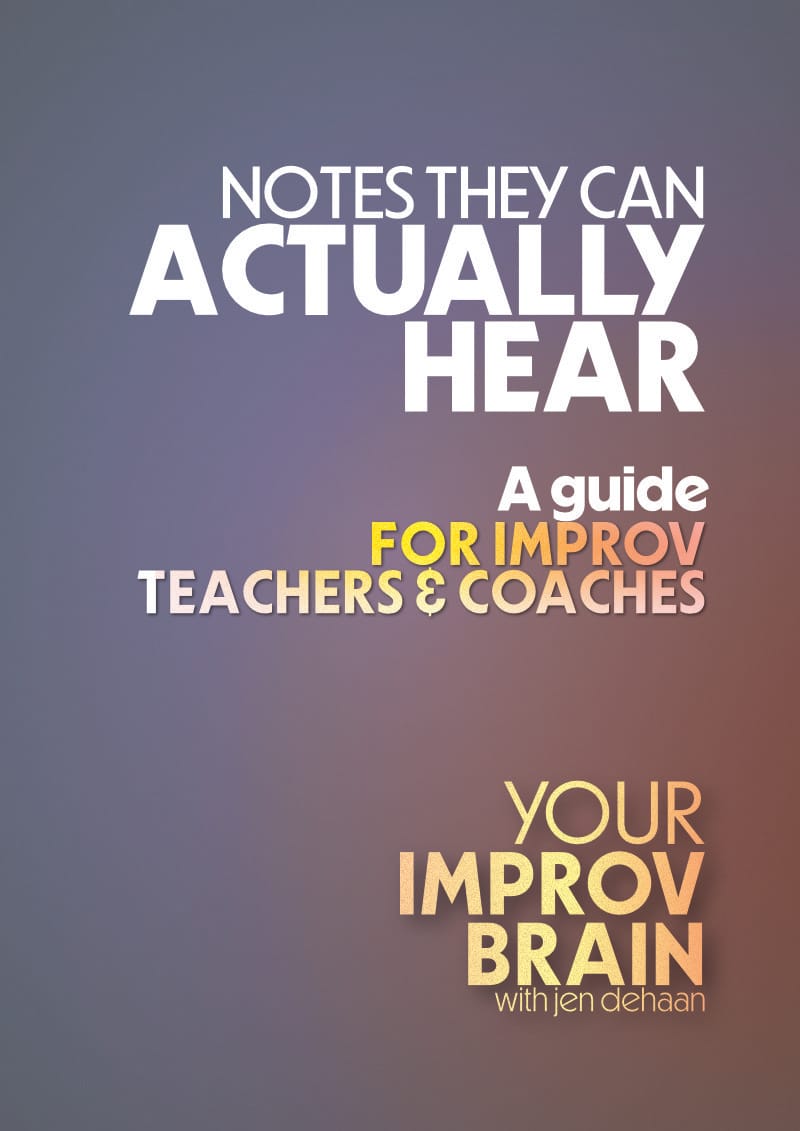
Notes They Can Actually Hear: Teachers Guide
27 Page Guide (with drawings!) for improv teachers and coaches. Get both guides for a discount.
Get the Guide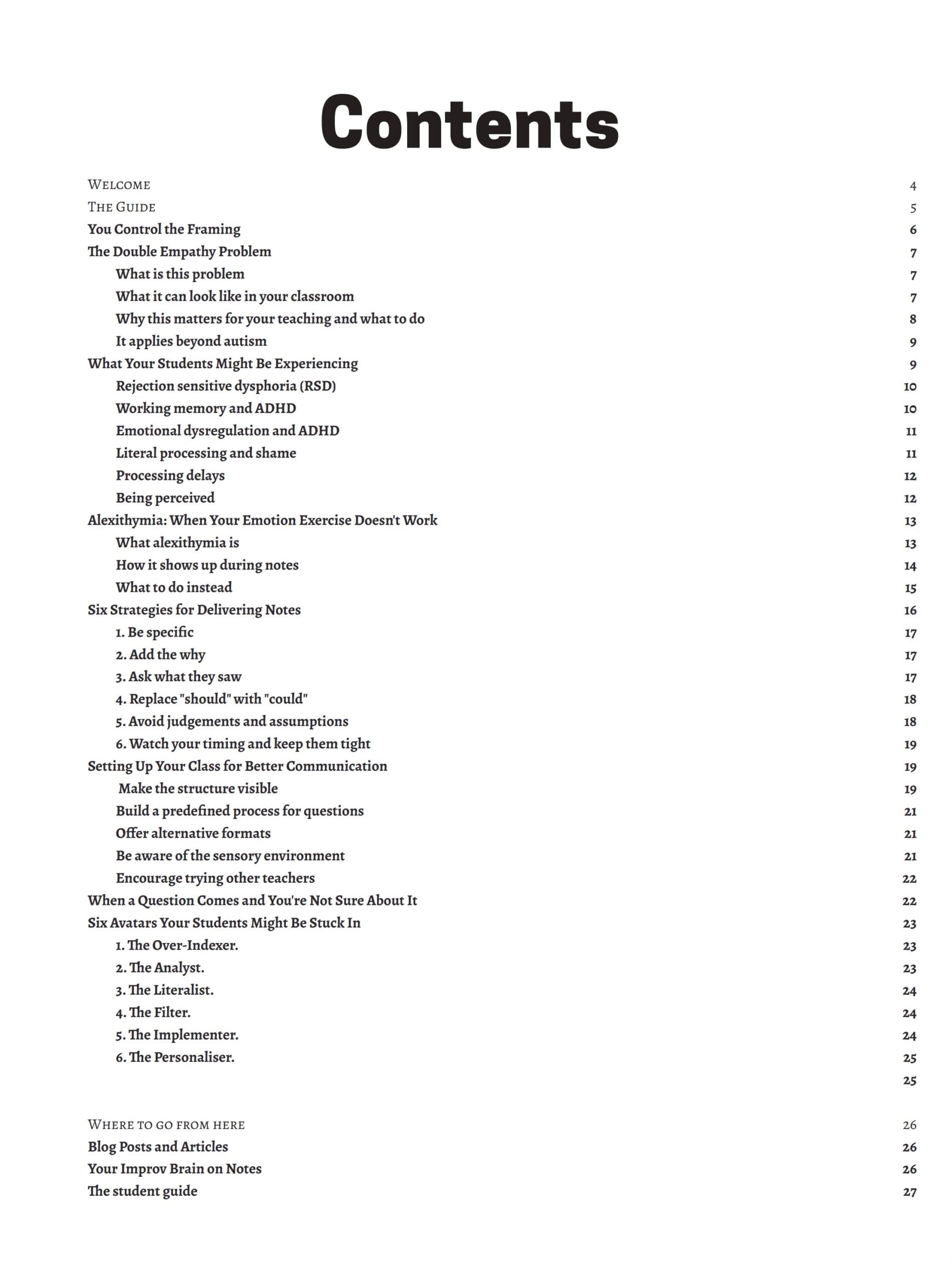
Watch or listen to this episode
Understanding notes and applying them takes practice! I made a new episode about all of this, and I go into exercises you can try with a scene partner and on your own. I also have a PDF and workbook for getting and receiving notes at improvupdate.com/notes if you want something structured to work with. Check out the latest ep here:
Receiving Improv Notes: How Your Brain Rewrites Feedback

Mentioned in this episode
- Contact BOC: https://www.instagram.com/b3oc
- BOC will travel to teach you! https://highwireimprov.com/boc-tour/
- Watch Billy Mai in this movie: https://www.imdb.com/title/tt0089491
- Free PDF note tracker: https://learn.improvupdate.com/products/post-improv-productive-reflection
- Evidence based approach episode: https://improvupdate.com/why-just-be-confident-doesnt-work-and-what-to-do-instead/
Metacognition in improv series
The full series is now released. Here are the articles, YouTube videos, and podcast episodes. The playlists will be updated as the series is released.
Articles
Receiving improv notes and understanding how your brain rewrites the feedback
ADHD, Autism, Improv, improv exercises, Neurodivergent, Neurodiversity, Solo improv, Your Improv Brain Show
Every piece of feedback has two layers. There’s the content, the actual information about what happened in the scene. And then there’s the framing, which is how that information arrives. The tone of voice, whether it was said in front of the class or privately, whether your inner critic added its own spin before you…
How to stop defaulting to your old improv habits
ADHD, Autism, Improv, improv exercises, Neurodivergent, Neurodiversity, Solo improv, Your Improv Brain Show
You learn a new improv skill, you understand it, you could explain it to someone else in plain language, and then you get into a scene and your brain does the old thing anyway. The thing you did before you learned the skill. The planning ahead, the talking over your scene partner, the same safe…

Why "just be confident" doesn't work (and what to do instead)
ADHD, Autism, Improv, improv exercises, Neurodivergent, Neurodiversity, Solo improv, Your Improv Brain Show
I heard this thing on a clip from the olympics: “I’m an evidence person, not an affirmations person” and I was like “damn, that’s why I really dislike the phrase “you got this.” And a lot of other phrases in that category of phrase. I think it’s because they always felt empty. I have said…

Metacognition and improv: how to use your monitoring brain in a scene
ADHD, Autism, Improv, improv exercises, Neurodivergent, Neurodiversity, Solo improv, Your Improv Brain Show
“Get out of your head” is advice that almost every improviser has heard at some point. It makes sense as a goal, but it skips over something worth looking at: what your brain is actually doing when you’re in a scene. During the 2026 Winter Olympics, freestyle skier Eileen Gu gave an interview that got…
Podcast series
Episodes will be added to this list as they are added to the series. You do not have to listen to anything together, or in order… they all stand alone.
Video series
Episodes will be added to this list as they are added to the series. You do not have to listen to anything together, or in order… they all stand alone.
Receiving Improv Notes: How Your Brain Rewrites Feedback


Your Brain Rewrites Feedback About Your Scene (Here's Why & What to Do)
How to rewire your brain to break bad improv habits (plus… exercises!)
Your Brain Knows When You're Lying to It: Confidence in Improv
The Monitoring Channel: What Eileen Gu Taught Me About Improv